
At 22 years old, Forest Greece had every reason to be excited about the future.
A lifelong athlete and sports fan, Forest had just earned his master’s degree in organizational leadership and started his dream job with the New York Yankees. He grew up in Croton-on-Hudson and had always been active. He played football and basketball, then went on to compete as a Division III football player at Widener University.
Then, last fall, everything changed. Forest began having seizures. At first, doctors thought they may have been linked to a head injury from college football. But imaging showed something else: a non-cancerous tumor deep in the right side of his brain. The tumor was causing the seizures and would need surgery.
Forest was referred to Simon Hanft, MD, Section Chief of Neurosurgical Oncology at Westchester Medical Center (WMC). Dr. Hanft recommended a minimally invasive procedure offered at WMC. The procedure could treat the tumor while helping Forest avoid the larger incision and longer recovery that can come with traditional brain surgery.
“When we first met, Dr. Hanft was ready to operate,” Forest recalls. “I had just started my new job, so we needed to figure out the timing. We found a window that worked.”
Rather than perform traditional open brain surgery, Dr. Hanft used a robotic system to guide a small laser tool to the tumor with great accuracy. Once in place, the laser heated the tumor and destroyed the abnormal tissue while helping protect the healthy brain tissue around it.
“For patients with tumors like Forest’s, this approach lets us reach areas of the brain that would otherwise need a much larger operation,” says Dr. Hanft. “Because the procedure is minimally invasive, patients often have less pain, shorter hospital stays and a faster recovery.”
The surgery took place on a Monday.
Forest went home the very next day.
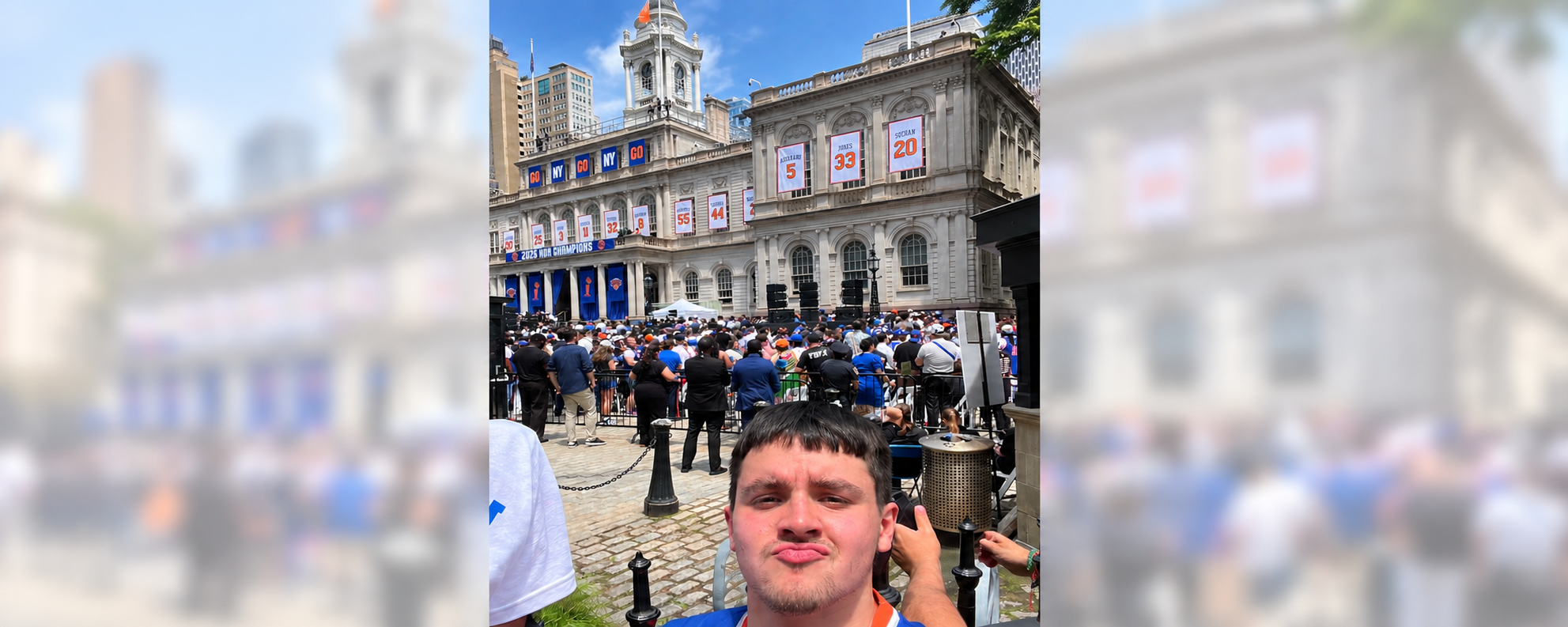
Just three days later, he was standing among millions of fans in lower Manhattan celebrating the New York Knicks’ historic championship parade.
“I was sleeping a lot those first few days,” Forest says with a laugh. “But according to my parents, when I woke up after surgery, all I kept saying was, ‘Let me get on the train.'”
Dr. Hanft remembers giving Forest one simple piece of advice before the celebration.
“I told him he could go,” he says with a smile. “Just no drinking, and stay hydrated.”
For Forest, making it to the parade was about much more than basketball. It was proof that he was getting his life back.
The biggest victory, though, came after he returned home.
“Ever since the surgery, I haven’t had a seizure,” Forest says. “That’s been awesome.”
Today, Forest is settling into his new job, looking forward to getting back to the gym and enjoying the active lifestyle he has always loved. He has stayed in touch with Dr. Hanft during his recovery. He has shared photos from the parade and checked in as he works toward returning to his regular workout routine.
“For someone as young and active as Forest, our goal was not only to treat his tumor, but to help him get back to his life as quickly and safely as possible,” says Dr. Hanft. “Seeing him back at work, with friends and enjoying a milestone like the Knicks parade just days after surgery is exactly the kind of outcome we hope for.”
Looking at the photos from that day, it is hard to believe Forest had undergone brain surgery only three days earlier.
For Forest, the parade was more than a celebration of the Knicks. It was a celebration of getting his life back.