

On January 25, 2026, a winter storm was intensifying in the Hudson Valley. Molly McCoskey, a healthy 14-year-old, was relaxing in her room while her mom, Laurie, got ready for work.
Molly felt fine when she woke up that day, but a few hours later, she texted Laurie that she couldn’t move her left arm.
“I went to check on her, and she was crying,” Laurie recalled. “She said, ‘Mom, I can’t move my arm.’ And when I looked at her, the entire left side of her face was drooping. I knew immediately what it was, even though I couldn’t believe it.” As a nurse manager with more than a decade of experience, Laurie recognized the signs of a stroke. But as a parent, she was in shock. “I remember thinking, she’s 14. This can’t be happening.”
Acting Fast
Molly’s family lives less than two miles from Hudson Valley Hospital. With snow falling heavily, Laurie made a split-second decision: drive her there immediately.
She ran through the emergency department doors yelling, “Code stroke! Code stroke!”
The response was immediate. Within minutes, Molly was in a CT scanner. The Hudson Valley team consulted with specialists at Westchester Medical Center, who advised administering clot-busting medication while arranging rapid transfer.
Because of the storm, traditional inter-hospital transport would have taken hours. Instead, Molly’s care team called 9-1-1. Local EMS was already waiting when the clot-busting medication finished infusing. In a remarkable show of coordination, a New York State snowplow escorted the ambulance down the Taconic Parkway to ensure a clear path to Westchester Medical Center.
“We were probably only at Hudson Valley for about 45 minutes,” Laurie said. “Everything just lined up in her favor that day.”
A Rare and Dangerous Diagnosis
When Molly arrived at Westchester Medical Center, the stroke team was ready.
“She had a blockage of the main artery supplying the right side of her brain,” explained Justin Santarelli, MD, endovascular neurosurgeon at Westchester Medical Center. “That’s why she developed sudden left-sided weakness and difficulty producing speech.”
Pediatric stroke itself is uncommon. A clot blocking a major brain artery in a child is rarer still. “I’ve been doing neurosurgery for 20 years,” Dr. Santarelli said. “I can’t remember the last time, if ever, I’ve seen this type of blockage in a 14-year-old.”
The team treated Molly with the same urgency used for adult stroke patients. “She was taken directly to the angiography suite,” Dr. Santarelli explained. “We performed a minimally invasive procedure called a thrombectomy. Through a catheter inserted in the groin artery, we guide instruments up into the brain and use a stent and suction to remove the clot.”
Within about 20 to 25 minutes, blood flow was fully restored to Molly’s brain.
Time Is Brain
“If there had been a significant delay in her care, the damage to Molly’s brain may have been permanent,” Dr. Santarelli said. In stroke care, physicians often say, “Time is brain.”
The longer the brain tissue is deprived of oxygen, the more irreversible damage occurs. In Molly’s case, the rapid recognition of symptoms, immediate clot-busting medication, coordinated EMS transfer and swift surgical intervention made all the difference.
“When she woke up from anesthesia,” Dr. Santarelli recalled, “she already had significantly improved strength on her left side.” Her recovery began almost immediately.
By the time she left the Pediatric Intensive Care Unit, her facial droop had nearly resolved, and she had regained movement in her arm. She continues to work on strengthening her hand and improving sensation with occupational therapy.
Today, she is almost back to baseline.
A System Built for Moments Like This
Molly’s case reflects the strength of a coordinated stroke system across facilities.
Westchester Medical Center has developed pediatric stroke protocols to ensure children presenting with stroke symptoms are rapidly evaluated and treated. “As a major medical center that deals with stroke, we are capable of managing stroke in the pediatric population,” Dr. Santarelli said. “Time can be of the essence in providing the best possible treatment, including thrombectomy surgery.”
For Laurie, who is accustomed to leading clinical teams herself, Molly’s care teams’ collaboration was striking. “We were included in interdisciplinary rounds. Every service was on the same page. They explained every scan, every step,” she said. “As a nurse, I was incredibly impressed. As a mom, I was incredibly grateful.”
Looking Forward
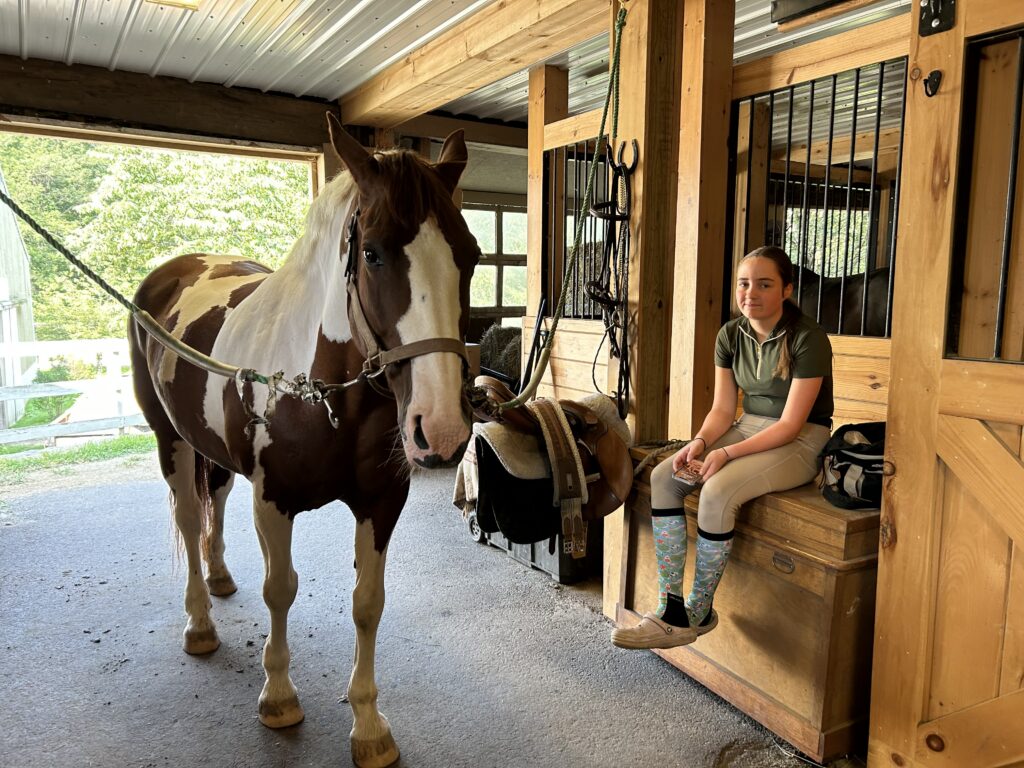
Molly is an avid equestrian. She rides competitively and even teaches lessons. Her future plans revolve around working with horses.
“She hasn’t been cleared to ride just yet,” Laurie said. “But she’s already back at the barn teaching lessons. That was huge for her.”
There are still questions about what caused the clot. Specialists are completing hematologic and genetic testing, and cardiology identified a small hole in her heart, which may be a pathway for the clot to be addressed in the future. But the most important outcome is clear: She has her life back.
What Parents Should Know
Although rare, strokes can happen in children. Symptoms mirror those in adults and should never be ignored:
- Sudden weakness or numbness on one side of the body
- Facial drooping
- Difficulty speaking
- Sudden confusion
“Even though stroke is rare in children, it’s still a possibility,” Dr. Santarelli said. “If those symptoms appear, seek immediate medical attention.”
Because sometimes, even in the middle of a snowstorm, acting fast can save a life.