

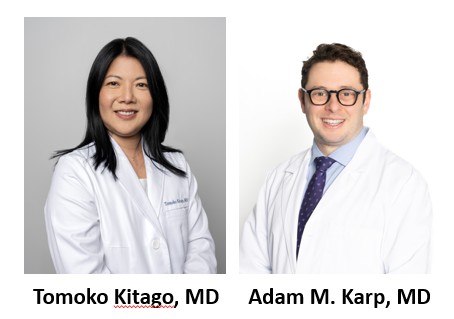
Message from Program Directors
Welcome to the Vascular Neurology Fellowship at Westchester Medical Center. We offer a one-year, ACGME-accredited fellowship with two positions each year, set within a Comprehensive Stroke Center serving the Hudson Valley.
Our program is dedicated to training the next generation of stroke neurologists in a collaborative, supportive, and academically rigorous environment. As a fellow, you will join a close-knit team that values open communication, mentorship, and continuous learning. Wherever your path leads, our goal is to help you build the skills to succeed in your career and to contribute meaningfully to the advancement of stroke care.
Tomoko Kitago MD, Program Director
Adam Karp MD, Associate Program Director
Educational & Curriculum Content
Westchester Medical Center is proud to be a Comprehensive Stroke Center. This distinction reflects our high level of expertise in cerebrovascular care and our role as a major regional referral center for patients with complex cerebrovascular diseases. Each year, we admit more than 700 stroke patients, and our trainees care for patients with a wide range of cerebrovascular diagnoses including ischemic stroke, intracerebral hemorrhage, subarachnoid hemorrhage, vasculitis, dural sinus thrombosis and vascular malformations. Our fellows participate in all aspects of clinical care: from the ER to our advanced Neuro ICU equipped with multimodality monitoring, to stepdown units and outpatient follow-up. This comprehensive training ensures that graduates are prepared to manage patients across all levels of acuity and complexity.
Detailed PGY curriculum structure
- 18 weeks on the stroke inpatient and 8 weeks on the stroke consult service
- The remaining weeks include rotations which are individualized based on the interests of the fellow. Rotations are available in telestroke, neurosonology, neurocritical care, neuroendovascular surgery, neurorehabilitation, palliative care, and research.
- Outpatient clinic – half day per week of continuity clinic staffed with stroke faculty, during the weeks when the fellow is not covering the inpatient or consult service
Call schedule structure
- The fellows will take at-home call while on the stroke inpatient and consult services. Fellows are on call along with a stroke attending to support learning regardless of time or day.
Didactic curriculum and conference information
- Weekly neurovascular conference with stroke and neuroendovascular faculty and trainees
- Weekly stroke clinical case meetings
- Monthly fellow-led stroke journal club
- Monthly Stroke Committee meetings
- Quarterly joint cerebrovascular conference with neurosurgery
Research, scholarly activity, and mentorship opportunities
- The fellows work with our faculty on clinical research and quality improvement projects throughout the year. Our previous fellows have successfully published in peer reviewed journals and presented their work at national meetings. WMC also participates in cutting-edge multicenter clinical trials as a NIH StrokeNet site, with trials in acute stroke treatment, stroke prevention, and recovery including SISTER, ASPIRE, and VERIFY. Our stroke and neuroendovascular faculty are also actively involved in many other industry-sponsored and investigated-initiated clinical trials and research projects. Additionally, fellows are encouraged to work closely with our dedicated faculty on research projects of their choosing.
Recruitment & Applicant Resources
Qualifications
- Applicants must have successfully completed or be on track for successful completion of an ACGME accredited Neurology Residency (Adult Neurology residency must be completed prior to the starting the Vascular Neurology Fellowship).
- Westchester Medical Center will accept individuals on J1 Visas sponsored by the ECGMG/Intealth.
Application Process
- Our program will be accepting applications through ERAS for the fellowship position starting July. Applicants must upload their C.V., three letters of recommendation including one from the current program director, a personal statement and USMLE scores into the ERAS program. Applications will be reviewed starting December 1st and ERAS will close on May 31st. Interviews will be conducted in January.
Program-specific differentiators and highlights
- Dedicated faculty of vascular neurologists with research interests ranging from endovascular care to medical education to neurorehabilitation to patient access and quality improvement.
- Primary regional hub with frequent transfers from a large geographic area providing the opportunity to care for a broad and diverse patient population.
- Access to unparalleled mentorship from a growing and engaged clinical neurosciences faculty
- Close, collaborative relationship with adjacent divisions including neuroendovascular surgery and neurocritical care ensuring the best possible multidisciplinary care for cerebrovascular patients.
- Regional NIH StrokeNet site actively involved with and enrolling for multiple large, cutting edge, multicenter stroke trials.
- Flexible schedule with a plethora of elective opportunities allows fellows to ensure they receive the training and experiences they need to pursue the next steps in their professional journey.
Resident & Fellow
Program culture, wellness initiatives, and support resources
As a fellow, you are a valued member of a team that knows you well and is invested in your success. We work closely together and make time to have fun as a group. We celebrate your milestones and support you through the challenges, with a mentoring program built on direct faculty access and a sustainable, wellbeing-minded approach to training.
Community and lifestyle information
Westchester County is consistently ranked among the best places to live in the United States. Our fellows benefit from an exceptional quality of life- the natural beauty and tight-knit community of the Hudson Valley, combined with New York City’s energy just 30 miles away. At WMC, we think you’ve landed in one of the best spots in the country to do it.
Tomoko Kitage,MD Program Director Vascular Neurology Fellowship
Fawaz Al-Mufti,MD Director of Neuroendovascular Surgery and Neurology Research
Adam Karp,MD Associate Program Director Vascular Neurology Fellowship
Gurmeen Kaur MBBS Attending, Stroke and Neurointerventional
Feliks Koyfman,MD Faculty/Attending Stroke
Christeena Kurian,MD Attending Neurologist (Stroke Section)
Chaitanya Medicherla,MD Faculty/Attending Stroke
Sarah Parauda,MD Faculty/Attending Stroke
Neisha Patel,MD Faculty/Attending
Divya Viswanathan,PA Physician Assistant Stroke Program
2025-2026 Abdalla Albanna
- Neurology residency at Henry Ford Health
- Current and future positions: Fellowship in clinical neurophysiology at Detroit Medical Center, fellowship in neuroendovascular surgery at Westchester Medical Center
2024-2025 Vikalpa Dammavalam
- Neurology residency at Stony Brook University
- Current position: Fellowship in neuroendovascular surgery, University of South Florida
2023-2024 Kalimullah Jan
- Neurology residency at Temple University
- Current position: Fellowship in neuroendovascular surgery, Medical College of Wisconsin
Our Clinical Locations
Westchester Medical Center
Westchester Medical Center shares its leafy campus with New York Medical College in Valhalla, NY, approximately 20 miles north of New York City. It is a Level 1 Trauma and Burn Center and a major hub for specialized care referrals. Here, we take care of patients from a very large catchment area stretching from the northern border of New York City to the Catskill Mountains.
WMC has a pediatric hospital (Maria Fareri Children’s Hospital) with eight dedicated pediatric operating rooms as well as many other non-operating room anesthetizing sites, including MRI, radiation and nuclear medicine, and endoscopy. The Ambulatory Care Pavilion, which opened in July 2019, added many anesthetizing locations, both OR and Non-OR.
Construction is underway on the 128-bed state-of-the-art WMC Critical Care Tower, a $220 million project that when completed will span 162,000 square feet over five floors. Our caseload includes a full profile of cardiac, interventional pulmonary and thoracic, complex orthopedic, neurosurgical and solid organ transplant interventions, to name the busiest services. We have a large heart failure and ECMO referral program. Trauma orthopedics and surgery provide our residents a great variety of “open” cases. Residents participate in minimally invasive and robotic interventions in gynecologic-oncology, urology, colorectal, endocrine and thoracic surgery, as well as complex cardiac and neurological endovascular interventions, both pediatric and adult. The Acute and Chronic Pain Management care rotations cover both the pediatric and adult inpatients and outpatients, including complex consultations for patients in the Burn ICU.