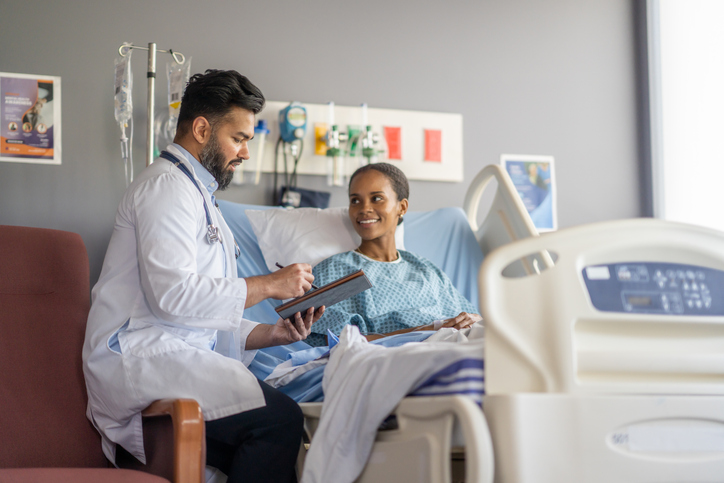
If you have a blocked artery in your heart, a stent can open it up and improve blood flow. Stents are often used to treat conditions like coronary artery disease, chest pain (angina), or complications following a heart attack. They can help reduce symptoms such as shortness of breath or tightness in your chest and support overall heart function.
At WMCHealth, we place stents using less invasive techniques that focus on your safety and comfort. Whether your procedure is planned or done in an emergency, you’ll receive expert care.
What Is a Heart Stent?
A heart stent is a tiny, mesh-like metal tube placed inside a narrowed or blocked artery in your heart. Your interventional cardiologist places the stent using a thin, flexible tube called a catheter, which is guided through a blood vessel to your heart. It helps hold the artery open after an angioplasty so that blood can flow more freely to the heart muscle.
Types of Stents
There are two common types of stents—bare-metal and drug-eluting:
- Bare-metal stents are simple mesh tubes that hold the artery open.
- Drug-eluting stents do the same as bare-metal but also release medicine over time to prevent the narrowing from coming back.
Your care team will recommend the best option based on your health and treatment goals.
What to Know About Your Heart Stent Procedure
Here’s what you can expect before, during, and after your heart stent placement.
How to Prepare
Your care team will give you clear instructions before your procedure. These may include:
- Do not eat or drink for six to eight hours before your appointment.
- Tell your care team about all medications, including blood thinners and diabetes treatments.
- Share any allergies, especially to contrast dye or iodine.
- Wear comfortable clothing to your appointment.
- Arrange for someone to drive you home.
What to Expect During the Procedure
Your heart stent procedure takes place in a cardiac catheterization lab, performed by one of our interventional cardiologists. You’ll be awake but relaxed:
- A numbing medicine is used on your wrist or groin.
- A catheter (thin, flexible tube) with a small balloon tip is inserted into a blood vessel and guided to your heart.
- The balloon is gently inflated to open the artery and make space for the stent.
- The stent is placed in the artery to help keep it open.
- The balloon and catheter are then removed.
Most procedures last between 30 and 90 minutes.
What to Expect After
Once the procedure is done, you’ll recover in a special care area. Your care team will monitor your heart and the catheter site. During recovery, you can expect:
- Lying flat for a few hours if the catheter was placed in your groin
- Mild soreness or bruising at the insertion site
- Going home the same day or after a short overnight stay
- Activity limits, new medications (blood thinners and cholesterol medications), and follow-up instructions
You may also be referred to cardiac rehab or asked to make heart-healthy lifestyle changes. These steps help you heal and lower your risk of future heart issues.

Walter E. Kaufmann
Cardiovascular Disease
Locations:
-
5 Skinner St
Port Jervis, NY 12771
 WMCHealth Provider

Andrew Najovits
Cardiovascular Disease, Echocardiography, Nuclear Cardiology
Locations:
-
257 Lafayette Avenue Suite 300
Suffern, NY 10901
WMCHealth Provider

Hratch Kazanjian
Cardiovascular Disease
Locations:
-
30 Hatfield Lane
Goshen, NY 10924
WMCHealth Provider

Chhaya Gupta
Advanced Heart Failure and Transplant Cardiology
Locations:
-
257 Lafayette Avenue Suite 330
Suffern, NY 10901
WMCHealth Provider

Andrew C. Shih
Interventional Cardiology, Cardiovascular Disease, Internal Medicine
Locations:
-
257 Lafayette Avenue Suite 285
Suffern, NY 10901
WMCHealth Provider

Ahmed Alabbady
Interventional Cardiology
Locations:
-
1 Crosfield Avenue Suite 101
West Nyack, NY 10994
WMCHealth Provider

Richard Cantor
Cardiovascular Disease, Nuclear Cardiology, Internal Medicine, Echocardiography
Locations:
-
2 Executive Boulevard
Suffern, NY 10901
WMCHealth Provider

Amala Chirumamilla
Cardiovascular Disease, Echocardiography, Nuclear Cardiology
Locations:
-
257 Lafayette Avenue Suite 300
Suffern, NY 10901
WMCHealth Provider

Seth Hurwitz
Cardiovascular Disease, Echocardiography, Nuclear Cardiology
Locations:
-
30 Hatfield Lane
Goshen, NY 10924
WMCHealth Provider

John Zimmerman
Clinical Cardiac Electrophysiology, Cardiovascular Disease
Locations:
-
30 Hatfield Lane
Goshen, NY 10924
WMCHealth Provider

Cary L. Hirsch
Interventional Cardiology, Cardiovascular Disease
Locations:
-
257 Lafayette Avenue Suite 300
Suffern, NY 10901
WMCHealth Provider

Gunjan J. Shukla
Clinical Cardiac Electrophysiology, Cardiovascular Disease
Locations:
-
257 Lafayette Avenue Suite 330
Suffern, NY 10901
WMCHealth Provider

Savalan Babapoor
Clinical Cardiac Electrophysiology
Locations:
-
257 Lafayette Avenue Suite 330
Suffern, NY 10901
WMCHealth Provider
Joseph Harburger
Cardiovascular Disease, Diagnostic Ultrasound, Internal Medicine
Locations:
-
100 Woods Road ACP 1st Floor
Valhalla, NY 10595
WMCHealth Provider

Divya Malhotra
Cardiovascular Disease
Locations:
-
100 Woods Road ACP 1st Floor
Valhalla, NY 10595
WMCHealth Provider

Arvind Agarwal
Cardiovascular Disease, Internal Medicine
Locations:
-
12 Liberty Square Mall
Stony Point, NY 10980
WMCHealth Provider

Lee P. Root
Cardiovascular Disease, Internal Medicine, Echocardiography, Nuclear Cardiology
Locations:
-
972 Route 45 Suite 103
Pomona, NY 10970
WMCHealth Provider

Stephen Pan
Advanced Heart Failure and Transplant Cardiology, Cardiovascular Disease
Locations:
-
257 Lafayette Avenue Suite 330
Suffern, NY 10901
WMCHealth Provider
Gregg M. Lanier
Advanced Heart Failure and Transplant Cardiology
Locations:
-
257 Lafayette Avenue Suite 330
Suffern, NY 10901
WMCHealth Provider

Alan Gass
Advanced Heart Failure and Transplant Cardiology
Locations:
-
257 Lafayette Avenue Suite 330
Suffern, NY 10901
WMCHealth Provider