
If everyday activities like walking, climbing stairs, or doing chores leave you feeling breathless or unusually tired, it may be time for a closer look. Cardiopulmonary exercise testing (CPET) is often used when symptoms like shortness of breath or tiredness don’t have a clear cause. It’s also used to assess fitness before surgery, monitor heart or lung conditions, or guide safe exercise in rehabilitation.
At WMCHealth, CPET is part of the expert heart and lung care we provide. Our cardiovascular and pulmonary specialists perform and use CPET test results to uncover the cause of your symptoms. This means your next steps for treatment are specific, effective, and built around your needs.
What is Cardiopulmonary Exercise Testing?
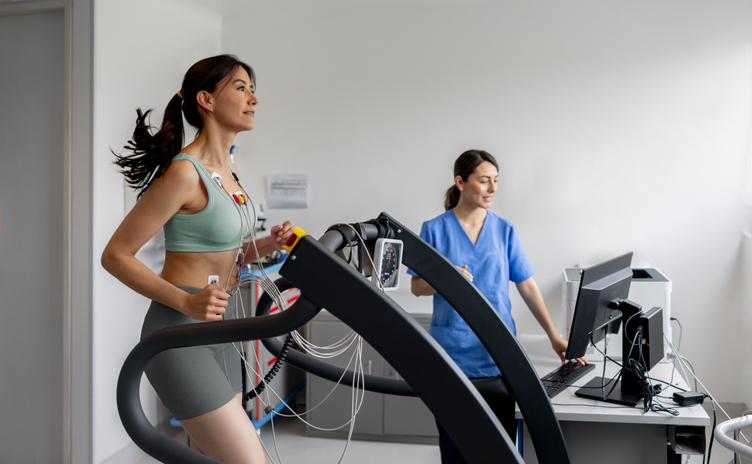
- How much oxygen your body uses
- How much carbon dioxide you breathe out
- How fast your heart and lungs respond during exercise
What to Know About Your CPET
Here’s what to expect before, during, and after your cardiopulmonary exercise test.
How to Prepare
Follow these steps to get ready for your CPET:
- Avoid eating for two to three hours before your test.
- Wear athletic shoes and loose, comfortable clothing.
- Do not use lotions or oils on your chest or arms.
- Bring a list of medications and follow your provider’s instructions on which ones, if any, to stop taking ahead of your test.
- Tell your care team if you have asthma, COPD (chronic obstructive pulmonary disease), or other lung conditions.
What to Expect During the CPET
One of our respiratory therapists or exercise physiologists will guide you through the test and ensure your safety:
- Electrode leads (small, sticky pads) are placed on your chest to check your heart rate. A cuff is placed on your arm to monitor your blood pressure. A pulse oximeter (a small, painless sensor) is clipped to your finger, earlobe, or forehead to track how much oxygen is in your blood.
- You’ll wear a mask or mouthpiece so we can measure your breathing.
- You’ll start walking on a treadmill or pedaling on a bike, with the pace slowly increasing.
- You’ll be asked to continue until you reach a set limit or experience symptoms.
The full test typically lasts 45 to 60 minutes, including setup and recovery.
What to Expect Afterwards
After the test, you’ll have a short cool-down period. Then, you can likely return to normal activities.
A cardiologist or pulmonologist on your care team will review your test results. They’ll look closely to determine whether a heart or lung condition is the cause of your symptoms. Then they’ll talk with you about next steps for care.

Walter E. Kaufmann
Cardiovascular Disease
Locations:
-
5 Skinner St
Port Jervis, NY 12771
 WMCHealth Provider

Andrew Najovits
Cardiovascular Disease, Echocardiography, Nuclear Cardiology
Locations:
-
257 Lafayette Avenue Suite 300
Suffern, NY 10901
WMCHealth Provider

Hratch Kazanjian
Cardiovascular Disease
Locations:
-
30 Hatfield Lane
Goshen, NY 10924
WMCHealth Provider

Chhaya Gupta
Advanced Heart Failure and Transplant Cardiology
Locations:
-
257 Lafayette Avenue Suite 330
Suffern, NY 10901
WMCHealth Provider

Andrew C. Shih
Interventional Cardiology, Cardiovascular Disease, Internal Medicine
Locations:
-
257 Lafayette Avenue Suite 285
Suffern, NY 10901
WMCHealth Provider

Ahmed Alabbady
Interventional Cardiology
Locations:
-
1 Crosfield Avenue Suite 101
West Nyack, NY 10994
WMCHealth Provider

Richard Cantor
Cardiovascular Disease, Nuclear Cardiology, Internal Medicine, Echocardiography
Locations:
-
2 Executive Boulevard
Suffern, NY 10901
WMCHealth Provider

Amala Chirumamilla
Cardiovascular Disease, Echocardiography, Nuclear Cardiology
Locations:
-
257 Lafayette Avenue Suite 300
Suffern, NY 10901
WMCHealth Provider

Seth Hurwitz
Cardiovascular Disease, Echocardiography, Nuclear Cardiology
Locations:
-
30 Hatfield Lane
Goshen, NY 10924
WMCHealth Provider

John Zimmerman
Clinical Cardiac Electrophysiology, Cardiovascular Disease
Locations:
-
30 Hatfield Lane
Goshen, NY 10924
WMCHealth Provider

Cary L. Hirsch
Interventional Cardiology, Cardiovascular Disease
Locations:
-
257 Lafayette Avenue Suite 300
Suffern, NY 10901
WMCHealth Provider

Gunjan J. Shukla
Clinical Cardiac Electrophysiology, Cardiovascular Disease
Locations:
-
257 Lafayette Avenue Suite 330
Suffern, NY 10901
WMCHealth Provider

Savalan Babapoor
Clinical Cardiac Electrophysiology
Locations:
-
257 Lafayette Avenue Suite 330
Suffern, NY 10901
WMCHealth Provider
Joseph Harburger
Cardiovascular Disease, Diagnostic Ultrasound, Internal Medicine
Locations:
-
100 Woods Road ACP 1st Floor
Valhalla, NY 10595
WMCHealth Provider

Divya Malhotra
Cardiovascular Disease
Locations:
-
100 Woods Road ACP 1st Floor
Valhalla, NY 10595
WMCHealth Provider

Arvind Agarwal
Cardiovascular Disease, Internal Medicine
Locations:
-
12 Liberty Square Mall
Stony Point, NY 10980
WMCHealth Provider

Lee P. Root
Cardiovascular Disease, Internal Medicine, Echocardiography, Nuclear Cardiology
Locations:
-
972 Route 45 Suite 103
Pomona, NY 10970
WMCHealth Provider

Stephen Pan
Advanced Heart Failure and Transplant Cardiology, Cardiovascular Disease
Locations:
-
257 Lafayette Avenue Suite 330
Suffern, NY 10901
WMCHealth Provider
Gregg M. Lanier
Advanced Heart Failure and Transplant Cardiology
Locations:
-
257 Lafayette Avenue Suite 330
Suffern, NY 10901
WMCHealth Provider

Alan Gass
Advanced Heart Failure and Transplant Cardiology
Locations:
-
257 Lafayette Avenue Suite 330
Suffern, NY 10901
WMCHealth Provider