
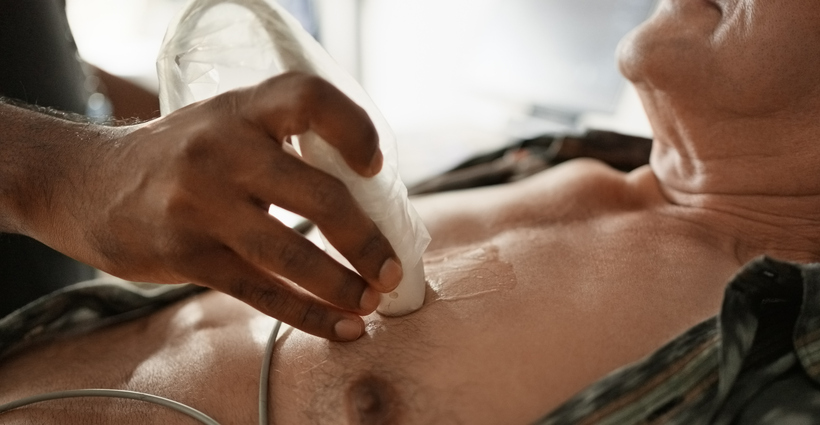
An echocardiogram uses sound waves to create moving images of the heart in real time. This noninvasive test helps assess heart size, valve performance, and blood flow.
Across the Westchester Medical Center Health Network, we use advanced imaging to take a closer look at how your heart is working. This helps us find what may be affecting your heart and choose the right treatment to help it work better.
What Is an Echocardiogram?
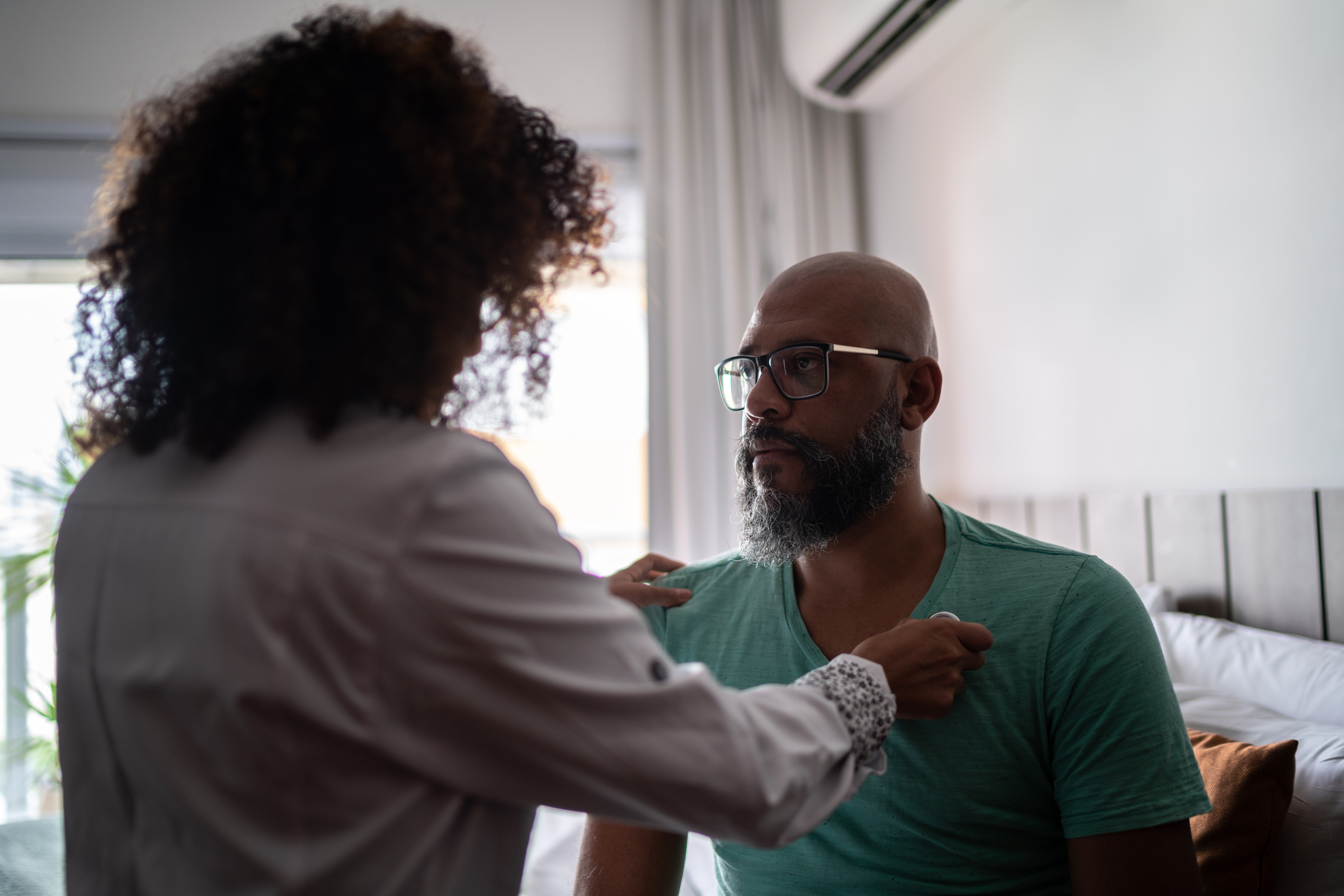
An echocardiogram (or echo) uses ultrasound to create live images of the heart. It evaluates the heart’s chambers, valves, and blood flow patterns.
Doctors may order this test for symptoms such as chest pain, shortness of breath, murmurs, or irregular heartbeat. Echocardiograms also help diagnose heart failure, valve disease, congenital conditions, and cardiomyopathy.
Types of Echocardiograms
Depending on your specific condition and symptoms, our cardiologists may perform either of the following:
- Transthoracic echocardiogram (TTE) to capture heart images through the chest wall.
- Transesophageal echocardiogram (TEE) to get a clearer view of the heart through the esophagus.
What to Know About Your Transthoracic Echocardiogram (Echo)
Here’s what you need to know about preparing for, undergoing, and recovering after an echocardiogram.
How to Prepare
- Wear comfortable clothing—you may be asked to change into a gown.
What to Expect During the Echocardiogram
Your echocardiogram will be performed by one of our cardiac sonographers and reviewed by our cardiologists specializing in heart imaging. Most echocardiograms take 30 to 60 minutes:
- The sonographer will take vital signs.
- Dim lighting is used during the exam.
- You will lie on an exam table while a sonographer places gel on your chest.
- A small device called a transducer is moved across your chest to capture heart images.
- You may be asked to breathe in certain ways or change positions for better views.
- In some instances imaging enhancement agents are used to better visualize your heart. This will require the staff to place an IV (intravenous).
What to Expect Afterwards
You can generally return to normal activities immediately after a transthoracic echo.
Your doctor will explain your echo results and recommended next steps. If needed, follow-up care may include medication, further testing, or consultation with a WMCHealth cardiologist.
What to Know About Your Transesophageal Echocardiogram (TEE)
How to Prepare
- A provider will call you the night before the exam to give you any specific instruction for you.
- For a transesophageal echo, fasting for six hours is typically required.
- You will be given sedation for this exam, so you will need to arrange a ride home.
What to Expect During the TEE
- Upon arrival in the pre-procedure area you will be greeted by our nursing team and an IV will be started.
- The potential benefits and risks of the procedure will be reviewed with you by one of our cardiology providers and an anesthesiologist. You will be asked to sign an informed consent form.
- One you are in the procedure room, sedation is administered by the anesthesiologist and your vital signs will be closely monitored.
- Once you are asleep, a thin tube (ultrasound camera) is passed down the throat to view the heart from the esophagus.
- The exam takes approximately 30 minutes.
What to Expect Afterwards
- You will need recovery time while sedation wears off.
- You will be monitored by our nurses until it is safe for your designated ride to take you home.
- Your doctor will explain your TEE results and recommended next steps. If needed, follow-up care may include medication, further testing, or consultation with a WMCHealth cardiologist.

John Zimmerman
Clinical Cardiac Electrophysiology
Locations:
-
257 Lafayette Ave Suite 330
Suffern, NY 10901
 WMCHealth Provider

Hratch Kazanjian
Cardiovascular Disease
Locations:
-
30 Hatfield Ln
Goshen, NY 10924
WMCHealth Provider
Aneta Dimova
Cardiovascular Disease
Locations:
-
111 Marys Avenue Suite 3
Kingston, NY 12401
WMCHealth Provider

Andrew Shih
Cardiovascular Disease
Locations:
-
257 Lafayette Avenue Suite 200
Suffern, NY 10920
WMCHealth Provider

Sharmila Sarkar
Cardiovascular Disease
Locations:
-
1 Crossfield Avenue Suite 101
West Nyack, NY 10994
WMCHealth Provider

Ahmed Alabbady
Interventional Cardiology
Locations:
-
12 Liberty Square Mall
Stony Point, NY 10980
WMCHealth Provider

Richard Cantor
Cardiovascular Disease
Locations:
-
2 Executive Blvd
Suffern, NY 10901
WMCHealth Provider

Adrienne Rascoe
Cardiovascular Disease
Locations:
-
575 Hudson Valley Avenue Suite 200
New Windsor, NY 12553
WMCHealth Provider
Dominica Potenza
Cardiovascular Disease
Locations:
-
100 Woods Road ACP 1st Floor
Valhalla, NY 10595
WMCHealth Provider
Gladys Pacenza
Cardiovascular Disease
Locations:
-
575 Hudson Valley Avenue Suite 200
New Windsor, NY 12553
WMCHealth Provider
Shubnum Singh
Cardiovascular Disease
Locations:
-
972 Route 45 Suite 103
Pomona, NY 10970
WMCHealth Provider
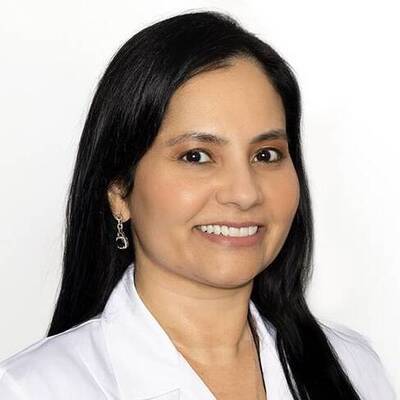
Jiji Abraham
Cardiovascular Disease
Locations:
-
100 Woods Road ACP 1st Floor
Valhalla, NY 10595
WMCHealth Provider
Muhammad Raufi
Interventional Cardiology
Locations:
-
575 Hudson Valley Avenue Suite 200
New Windsor, NY 12553
WMCHealth Provider
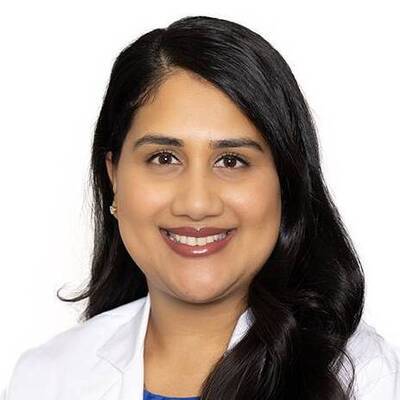
Daisy Yohannan
Cardiovascular Disease
Locations:
-
100 Woods Road ACP 1st Floor
Valhalla, NY 10595
WMCHealth Provider
Patricia Rainaldi
Cardiovascular Disease
Locations:
-
575 Hudson Valley Avenue Suite 200
New Windsor, NY 12553
WMCHealth Provider

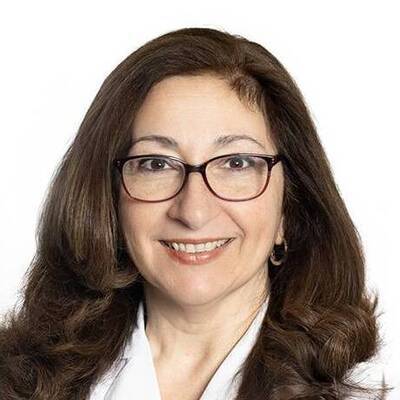
Carmela Musial
Cardiovascular Disease
Locations:
-
100 Woods Road ACP 1st Floor
Valhalla, NY 10595
WMCHealth Provider

Chhaya Gupta
Advanced Heart Failure and Transplant Cardiology
Locations:
-
100 Woods Road ACP 1st Floor
Valhalla, NY 10595
WMCHealth Provider

Savalan Babapoor
Clinical Cardiac Electrophysiology
Locations:
-
257 Lafayette Ave Suite 330
Suffern, NY 10901
WMCHealth Provider